
NIHONGOBASE LearningFor BusinessesContact Us (opens in a new window)
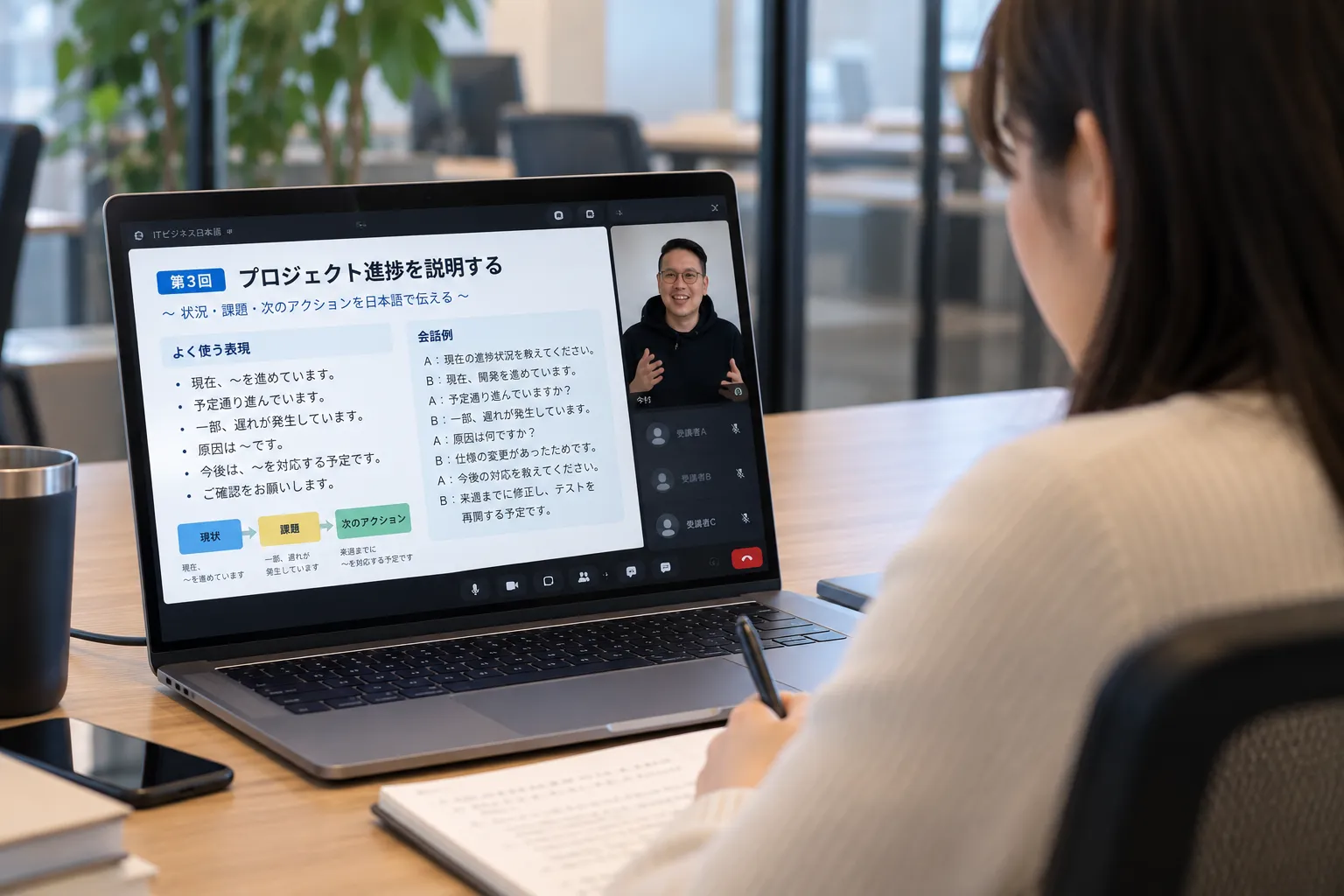
A learner taking notes during online training, with the teacher and a lesson on explaining project progress on screen

NIHONGOBASELearning for Business

Turn Japanese skillsinto real impact at work.

Business Japanese training tailored to each employee’s role and work

With a focus on IT and engineering, we also support professionals in consulting, manufacturing, and more.

Tailored to your training needs, team size, and schedule

  • FocusSpecializing in IT and engineering
  • CustomizedTailored to job roles, tasks, and Japanese proficiency
  • MethodProfessional learning materials + regular 1-on-1 sessions

Same training, different needs.

These are common challenges in developing international employees.

  1. Different Japanese levels and roles make one-size-fits-all training hard

    A new arrival and an experienced team member need very different Japanese. The same content can be too easy for some and too hard for others.

  2. Busy schedules make it hard to gather everyone at the same time

    Peak project periods, client-site work, and time differences with overseas offices mean schedules rarely line up. Relying only on sessions at fixed times can make it difficult to keep learning.

  3. JLPT certification does not always mean confidence in reporting and explaining at work

    Passing an exam requires different skills from explaining a situation in a meeting or asking a manager for advice. A JLPT level alone does not show how someone performs at work.

  4. What is learned in training does not always carry over to daily work

    Learners often don’t know how to use expressions from general materials in their own work. Practice that connects learning and work is needed.

The right learning for each person — with content and ongoing support.

Our training is not just live Japanese classes. It is built on content-based self-study, with regular sessions to put learning into practice, ask questions, and receive feedback.

  1. 01Step 01

    Learning Design

    • Plan learning around each person’s role, work, Japanese level, and challenges
  2. 02Step 02

    Content-based Learning

    • Use courses on platforms such as Udemy, alongside our own materials
    • Learners study at their own pace
  3. 03Step 03

    Mentoring & Practice

    • Regular 1-on-1 sessions for practice, questions, and feedback
  4. 04Step 04

    Review & Improvement

    • Adjust learning based on progress and challenges

Each review shapes the next learning cycle

For each learner
  • Topics matched to their level and work
  • Self-paced content learning
  • Individual feedback
For the organization
  • Training designed around your development goals
  • Shared skills strengthened across the team
  • Reviews of training progress

Training that fits your organization — and each person in it.

Three typical training models. These are not fixed plans; we adjust the content and combination to your goals.

  • 01

    1-on-1 Training

    An individual curriculum for each learner, supported by content learning and regular 1-on-1 sessions.

    How it works

    1. Content
    2. 1-on-1
    3. Feedback

    Includes

    • Individual curriculum design
    • Content-based learning
    • Regular 1-on-1 sessions
    • Output review and feedback
    • Reflection and adjustment

    Best for

    Learners work on their own challenges at their own pace.

  • 02

    Blended Training

    Individual learning and 1-on-1 sessions, combined with group training for the team.

    How it works

    1. Self-study
    2. 1-on-1
    3. Group

    Includes

    • Individual curriculum
    • Content learning
    • Regular 1-on-1 sessions
    • Group training
    • Exercises and discussions on shared topics

    Best for

    Address individual needs while building Japanese skills across the team.

  • 03

    Onboarding Training

    Japanese language and communication skills to help new employees prepare for and settle into work in Japan.

    How it works

    1. Understand the work
    2. Basics
    3. Practice

    Includes

    • Japanese training before and after joining
    • Communication in Japanese workplaces
    • Workplace terminology and business etiquette
    • Reporting, sharing updates, and seeking advice (Hō-Ren-Sō)
    • Role-specific professional Japanese
    • Exercises based on real work

    Best for

    Helping new international employees start work smoothly in Japan.

We propose the right training based on the number of learners, roles, work, Japanese levels, and your goals.

Japanese training tailored to your industry and work.

Choose an industry to see typical development challenges and training content.

Development challenge

Help engineers understand specs, discuss technical topics, and give review feedback in Japanese.

ALearning topics

  • IT terms and technical expressions
  • Reading specifications
  • Technical explanations
  • Code review comments

BWork situations

  • Daily stand-ups and regular meetings
  • Design reviews
  • Asking for advice in chat
  • Pre-release checks

CSample outputs

  • Technical explanation
  • Design and specification documents
  • Review comments

Development challenge

Help engineers share updates, ask for advice, and communicate effectively with clients while working on-site.

ALearning topics

  • Reporting, sharing updates, and seeking advice
  • Confirming specifications
  • Technical explanations
  • Q&A in meetings

BWork situations

  • Client meetings
  • Progress reporting
  • Incident communication
  • Confirming tasks

CSample outputs

  • Progress report
  • Incident report
  • Explanation to clients

Development challenge

Help consultants structure problems, explain logically, and lead proposals and discussions in Japanese.

ALearning topics

  • Structuring problems and issues
  • Logical explanation
  • Creating proposals
  • Discussion

BWork situations

  • Client interviews
  • Internal discussions
  • Proposal meetings
  • Reporting sessions

CSample outputs

  • Proposal deck
  • Problem analysis report
  • Presentation at a reporting session

Development challenge

Help teams give and confirm instructions and communicate accurately about quality between Japan and overseas sites.

ALearning topics

  • Industry and work terminology
  • Giving instructions and requests
  • Confirming and asking questions
  • Reporting quality issues

BWork situations

  • Regular meetings between sites
  • Confirming work instructions
  • Sharing spec changes
  • Quality meetings

CSample outputs

  • Work report
  • Defect report
  • Email confirming a spec change

Professional learning materials for real work.

Beyond materials for Japanese learners, we use content that Japanese professionals also use to build their skills.

No.ContentHow it is used in training
01IT Business JapaneseLearn Japanese for common situations in development meetings and team chats
02Japanese for Software EngineersPractice understanding specifications, explaining technical topics, and giving review feedback
03Business CommunicationBuild everyday work Japanese, such as reporting and speaking up in meetings
04Project ManagementLearn how to communicate plans, progress, and risks to stakeholders
05Business DocumentsWrite reports, proposals, and emails, and get feedback
06Work Case StudiesPractice explaining situations and decisions with cases close to real work
07Professional Courses (e.g. Udemy)Include courses that develop skills relevant to each learner’s role and goals

Materials are selected to match the training goals and learners. We will explain how materials are used when you consult with us.

Supporting you from the first conversation to the final review.

  1. 01Step 01

    Consultation

    We learn about the number of learners, their work, current Japanese levels, and your goals.

  2. 02Step 02

    Training Design

    We propose the format, materials, curriculum, and how the training will run.

  3. 03Step 03

    Training

    Content learning, 1-on-1 sessions, group training, and more.

  4. 04Step 04

    Review

    We review learning progress and completed work together.

Training designed around your challenges.

We design training around the number of learners, their roles, Japanese levels, and your development goals. Feel free to contact us.

FAQ

How many employees can join the training?

We propose a training format based on the number of learners. We will explain any conditions on group size when you contact us.

Can employees with different Japanese levels join together?

Yes. Individual curricula and 1-on-1 sessions are designed around each learner’s level and work. Topics shared across the team can also be covered in group training.

Can the training content be customized?

Yes. We design the training around roles, work, Japanese levels, and your goals.

How do content learning and 1-on-1 sessions work?

Learners study with the materials at their own pace and have regular 1-on-1 sessions for output review, questions, and feedback. We will recommend a session schedule that fits the training plan.

Can we request group training only?

Please tell us about your goals. We will explain the formats we can offer when you contact us.

Can the training be held online?

Training is generally delivered online, but we decide on the delivery method together with you, based on the training content and the learners’ circumstances.

How are the duration and price decided?

We share details individually, based on the training content, number of learners, and duration.

Can we check learners’ progress and results?

How progress is shared is decided with you when we design the training.

Have another question? Contact us about your training (opens in a new window)